
9 min read · For doctors, nurses, pharmacists, and healthcare professionals ready to enter the AI evaluation market
Somewhere right now, a platform is paying $90 an hour for a clinician to read an AI-generated clinical note and tell them what is wrong with it.Not a software engineer. Not a data scientist. A clinician - a nurse, a doctor, a pharmacist - who can look at an AI-generated output and say, with professional authority, whether it is safe, accurate, and appropriate for the patient context it was written for.That person is called a medical AI evaluator. And in 2026, the demand for them is running well ahead of the supply.The platforms currently advertising for medical AI evaluators - OpenTrain AI, Mercor, SME Careers, Outlier AI, DataAnnotation, Scale AI - are not posting these roles as a courtesy. They are posting them because clinical AI quality assurance is a bottleneck for the entire medical AI industry, and it is a bottleneck that can only be cleared by people with clinical training.If you have a clinical background - a medical degree, a nursing qualification, a pharmacy registration, a health informatics credential - you are already qualified for the most in-demand tier of AI evaluation work. This article tells you what the work involves, what it pays, how the rates vary by credential and specialty, and the exact steps to start collecting it.
What Medical AI Evaluation Actually Involves
Before the rates make sense, the work needs to be clear. Medical AI evaluation is not data labelling. It is not clicking through surveys. It sits closer to clinical audit - structured, evidence-referenced, professionally documented review of AI-generated clinical content.Here is what clinical AI evaluators are actually doing on live projects in 2026:
Clinical note and documentation review
AI systems are being used to generate SOAP notes, discharge summaries, referral letters, and clinical correspondence from audio recordings or structured inputs. Evaluators review these for clinical accuracy, appropriate medical terminology, correct medication names and dosages, and whether the clinical reasoning documented is sound.
Drug dosage and medication safety review
AI-generated medication advice, drug information responses, and prescribing recommendations are reviewed against current clinical formularies - BNF, BNF for Children, local formularies, Drugs.com. Evaluators identify incorrect dosages, missing contraindications, omitted drug-drug interactions, and inappropriate route of administration.
Diagnostic AI output evaluation
AI diagnostic tools and symptom checkers are reviewed for whether their differential diagnoses are clinically appropriate, whether they flag emergency presentations correctly, whether they account for the patient demographics in the prompt, and whether the clinical reasoning leading to the diagnosis is sound.
Patient communication AI review
Patient-facing AI tools - health chatbots, discharge instruction generators, medication information tools - are evaluated for health literacy appropriateness, scope compliance (does the AI give information or cross into advice?), safety flagging, and cultural appropriateness.
Clinical research and evidence review
AI systems generating clinical summaries, literature reviews, and evidence syntheses are evaluated for citation accuracy against PubMed and clinical databases, correct characterisation of study designs and conclusions, and appropriate confidence calibration when evidence is uncertain.
WHAT PLATFORMS ARE ACTUALLY HIRING FOR
The platforms are not looking for someone to click rating buttons. They are looking for someone who can say: 'This AI recommended 2000mg of metformin twice daily for a patient with Stage 3 CKD - that is four times the maximum recommended dose for this renal function level, and it omits the BNF contraindication for eGFR below 45.' That is a clinical judgment. It requires clinical training. And it is worth considerably more than a general evaluation task.
What the Work Pays, Current Rates by Credential
The rate range for medical AI evaluation is wide and the spread is not random. It tracks almost exactly with the level of clinical expertise required for the evaluation task. Here are current advertised rates from live platforms as of September 2026:
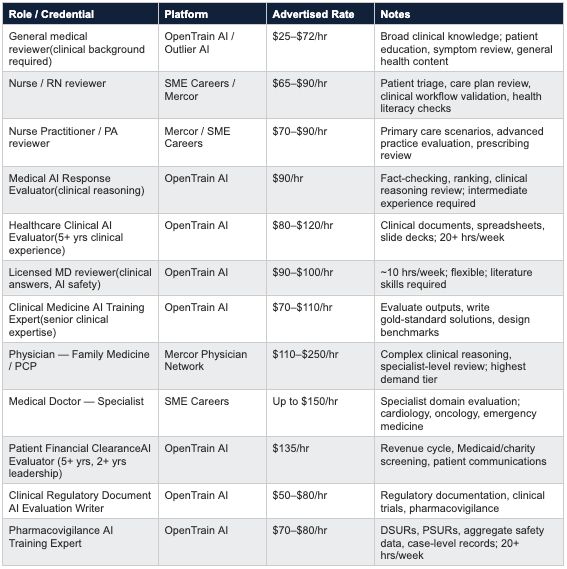
Sources: OpenTrain AI, Mercor, SME Careers, AITrainer.work - September 2026. Individual rates vary by task complexity, clinical experience, and weekly hour commitment.
The rate table above is not aspirational - these are current advertised rates from named platforms posting live roles in 2026. The demand signal is real and the rate differential between general evaluators and clinical specialists is structural, not temporary. AI companies cannot get clinical quality assurance from general evaluators. The clinical knowledge is irreplaceable, and the rates reflect it.
Why Clinical Expertise Is Irreplaceable - and Why That Won't Change Soon
A question worth asking directly: won't AI eventually be able to evaluate medical AI on its own? The short answer is that it already tries - and the results are well-documented enough to explain why platforms are still paying $90-$135 an hour for human clinical review.AI-based evaluation works reasonably well when the evaluation criteria are general - is this response helpful, is this tone appropriate, is this grammatically correct. It breaks down when evaluation requires clinical judgment:



The EU AI Act's classification of medical AI as high-risk - requiring mandatory human oversight - is not regulatory caution for its own sake. It reflects the documented reality that AI self-evaluation in clinical contexts is unreliable at exactly the failure modes that affect patient outcomes. The regulatory framework is building in permanent institutional demand for clinical human oversight.That regulatory demand is not going away. It is becoming more specific and more enforceable. For clinical professionals, it represents a durable structural opportunity - not a temporary window.
The Income Picture - What This Actually Looks Like in PracticeThe rates above describe the ceiling. What does realistic income look like for a clinician entering this market?The honest answer depends on three variables: your credential level, your weekly hours commitment, and whether you are working through platforms or directly with AI companies. Here are realistic scenarios for each major clinical credential group:
Nurses and advanced practice providersThe market for nurse evaluators is the most accessible entry point - SME Careers and Mercor both run open programmes for RNs, NPs, and PAs with no geographic restriction. The work - patient education review, triage scenario evaluation, clinical workflow validation, care plan review - maps directly to daily nursing practice.
Fifteen hours a week is realistic alongside clinical shifts. Many nurses complete evaluation tasks between shifts or during quieter periods. At $75/hour - the midpoint of the SME Careers / Mercor nurse range - fifteen hours generates over $58,000 annually as a supplement to primary clinical income.
General practitioners and junior doctors
OpenTrain AI's Medical AI Response Evaluator role, advertised at $90/hour and open to 17 countries including most of Africa, Asia, and Latin America as well as the US and Germany, represents one of the clearest entry points for doctors. The role involves clinical reasoning review, fact-checking, ranking AI responses, and writing model solutions.
Twenty hours per week at $90 an hour generates close to $94,000 annually - comparable to a junior doctor's salary in many markets, as a remote and flexible income stream alongside or instead of clinical practice.
Specialist physicians
The highest rates in the table - $110-$250/hour through Mercor's Physician Talent Network and up to $150/hour through SME Careers' specialist track - reflect the reality that specialist clinical knowledge is genuinely scarce in AI evaluation. A cardiologist evaluating cardiovascular diagnostic AI, an oncologist reviewing cancer screening outputs, an emergency physician evaluating triage AI - these evaluators cannot be replaced by general clinicians, and the rates reflect that.
Ten hours a week is a manageable commitment for a busy specialist. At $150 per hour it generates $78,000 annually. Specialists working 20+ hours in their domain area of highest demand can reasonably project significantly above that.
The Platforms - Where to Look and How to Get In
Five platforms are most actively hiring for medical AI evaluation work in 2026. Each has a slightly different focus, geographic eligibility, and qualification process:
OpenTrain AI (opentrain.ai)
The most diverse range of medical AI evaluation roles - clinical documentation, diagnostic review, patient communication, pharmacovigilance, regulatory writing, biostatistics. Open worldwide for most roles; some US-restricted. Rate range $25-$135/hr across role types. Strong portfolio of clinical subspecialty roles. Start at opentrain.ai and search Medical & Health.
Mercor / Mercor Physician Network
The highest-paying tier for physician evaluators - $110-$250/hr for primary care and specialist roles through the Physician Talent Network. Also runs RN and NP programmes. Requires rigorous vetting including credential verification. Application process is more selective - expect a multi-step assessment. Start at mercor.com.
SME Careers (smecareers.com)
Open worldwide; runs specific tracks for nurses ($65-$90/hr), nurse practitioners, and medical doctor specialists (up to $150/hr). Structured credential-based tracks with clear qualification pathways. Strong option for African and Asian clinicians - genuinely global eligibility.
Outlier AI / Scale AI
One of the largest RLHF platforms globally. Medical evaluation projects available but require passing a domain qualification assessment. Rate range $60-$100+ for domain expert evaluators. Apply at outlier.ai - select medical/healthcare as your domain expertise during onboarding.
DataAnnotation (dataannotation.tech)
Strong programme for healthcare professionals including specialist tracks. Assessment-based entry - you complete trial tasks before being accepted. Open worldwide with no geographic restrictions. Rates $40-$80/hr for clinical domain work.
PRACTICAL NOTE ON APPLYING
Apply to multiple platforms simultaneously. Each platform has its own onboarding timeline - sometimes two to six weeks from application to first paid task. Running applications in parallel means you are building multiple income pipelines rather than waiting sequentially. Being active on three platforms smooths out the task availability fluctuations that make single-platform dependence unreliable.
The Qualification Assessment - What You Need to Pass It
Every platform runs a qualification assessment before you access paid work. For clinical evaluators, this assessment is testing two things: your clinical knowledge and your evaluation methodology. Most clinicians arrive with strong clinical knowledge and weak evaluation methodology - and that is exactly where most assessment failures happen.Evaluation methodology means: the ability to apply a structured rubric systematically, verify specific claims against authoritative sources, and document your findings in professional evaluation language rather than clinical shorthand.The difference looks like this:
Both evaluators know the dosage is wrong. The second evaluator has produced something an AI company can use - a sourced, scored, risk-rated assessment with a clear recommended action. That is what structured evaluation methodology produces. And it is entirely learnable.The four components of structured clinical evaluation methodology that platforms are testing for:
1) Rubric application - scoring each clinical output on defined dimensions (accuracy, completeness, scope, population specificity, emergency recognition) consistently and with justification.
2) Source verification - naming the specific authoritative source for every factual claim checked (BNF section, UpToDate chapter, PubMed PMID, clinical guideline publisher and year).
3) Professional documentation - writing evaluation notes in formal report language, not clinical shorthand or conversational prose.
4) Red flag identification - recognising when an output crosses from 'needs improvement' into 'must not be deployed', and documenting the clinical basis for that classification.
The Step-by-Step Path to Your First Paid Clinical Evaluation Task
Most clinicians who try to enter this market without preparation arrive at the qualification assessment under-prepared and fail it - not because their clinical knowledge is insufficient, but because they have not developed evaluation methodology. Here is the sequence that gives you the highest probability of passing on the first attempt and accessing well-paying tasks immediately:
01 Complete structured AI evaluation training
Before you apply to any platform, complete a training programme that teaches you evaluation methodology in a clinical context - structured rubrics for clinical AI, the medical verification workflow (BNF → UpToDate → PubMed → clinical guidelines), red-flag documentation standards, and professional evaluation report writing. This is the step most people skip, and it is why most people fail the assessment or access only the lowest-paying tasks.
02 Build a practice portfolio before applying
Generate 15-20 clinical AI outputs using ChatGPT or Claude - a mix of medication questions, diagnostic prompts, patient communication scenarios, and clinical documentation tasks. Evaluate each one using a structured rubric. Verify every factual claim against the BNF or equivalent. Write professional evaluation notes. This is both preparation for the assessment and the beginning of your evaluation portfolio.
03 Apply to multiple platforms simultaneously
Apply to OpenTrain AI, Outlier AI, SME Careers, and DataAnnotation in the same week. Each has an independent onboarding timeline. If one takes six weeks, another may take two. Running applications in parallel compresses the time to your first paid task significantly.
04 Specify your clinical credential and specialty explicitly
Most platform applications ask about education level. They do not always prompt you to specify clinical specialty. Add it anyway - your specialty is your rate card. A general medical background gets you into the general tier. An emergency medicine background gets you into emergency medicine evaluation. A pharmacist's registration gets you into medication safety evaluation. Be specific.
05 Submit your evaluation portfolio with your application
Even when platforms do not require a portfolio, submitting one puts you in a different category from applicants who show up with credentials alone. A two-page portfolio summary - what you evaluated, what rubric you applied, what clinical issues you identified, your professional verdict - signals immediately that you understand what clinical AI evaluation actually involves.
A Word on the Direct Client Route
Platform work - Outlier, OpenTrain, Mercor - is where most clinical evaluators start. But it is not where the highest-value and most sustainable clinical AI evaluation income comes from.AI companies building medical AI products - clinical documentation platforms, diagnostic AI tools, patient-facing health chatbots, pharmaceutical information systems - need ongoing domain-expert evaluation of their products throughout the development and deployment cycle. Many of them prefer to hire clinical evaluators directly rather than through platforms, because direct relationships allow for longer-term engagement, deeper product knowledge, and faster feedback loops. Direct client rates consistently sit at the higher end of the range - $100–$150+ per hour - because the company is not sharing a platform fee and the evaluator is taking on more professional responsibility for the quality of the review.Getting there requires three things: a track record of platform evaluation work, a documented portfolio, and a professional credential that signals to a clinical AI company that your evaluation meets professional standards. The credential is not decoration - it is the signal that tells a Chief Medical Officer that your evaluation of their clinical AI product is the product of a structured, documented, professional methodology rather than an informal opinion.That is what the CAE - Certified AI Evaluator - designation, with its Medical Domain Endorsement, is designed to provide.
The Honest Picture of How This Works
There are two things worth saying directly that most guides about AI evaluation income do not say.First: the rates at the top of the table - $200+ per hour through Mercor's Physician Network - are real but not universal. They reflect specialist physicians with extensive clinical experience, strong documentation skills, and established relationships with platforms that have verified their credentials and tested their evaluation quality. They are a realistic target, not a starting point.Second: the income from clinical AI evaluation is genuinely flexible in a way that clinical work is not. You do not need to commit to shifts. You do not need to be in a specific location. You do not need to take on the full professional liability of clinical practice. For a clinician who is between positions, returning from parental leave, reducing clinical hours, or looking for income that does not require physical presence - the flexibility of evaluation work has value that the hourly rate does not fully capture.The market for clinical AI evaluation is real, it is growing, it is paying professional rates, and it is systematically under-served because the clinicians most qualified to do it are the ones least likely to know it exists. That information gap is closing - but it is still a gap.Your clinical training took years to develop. The AI evaluation methodology it needs to be commercially useful in this market takes weeks to learn. That is a reasonable trade.
Medical AI Evaluation - Track 2
Built for doctors, nurses, pharmacists, and healthcare professionals.5 modules · 33 lessons · ~16 hours · Clinical rubrics · Verification workflows · CAE Medical Domain Endorsement. Prerequisite: Track 1 - AI Foundations for Evaluators
→ Begin enrolment at crestedacademy.com/courses
Crested Academy offers professional AI evaluation training for domain experts. The Medical AI Evaluation track is a prerequisite-gated domain specialisation requiring completion of Track 1 - AI Foundations for Evaluators - first. Platform rate data sourced from OpenTrain AI, Mercor, SME Careers, AITrainer.work, and Second Talent - current as of September 2026. Individual rates vary by task complexity, credential level, and weekly hour commitment.
Pingback:Your Medical Degree Is Worth More in the AI Economy Than You Think – crestedacademy