
If you have been researching AI evaluation as a career, you have probably come across a concern that stops a lot of people in their tracks.
The concern goes like this: if AI is getting smarter, won’t AI companies just use AI to evaluate AI? Why would they pay humans at all?
It is a fair question. And it deserves a direct, honest answer — not the kind of reassuring non-answer that some training programmes give you because they want your enrolment regardless.
The honest answer is: yes, AI is being used to evaluate AI. It has been for several years. The technique is called RLAIF — Reinforcement Learning from AI Feedback — and it is a real, widely adopted method that has already replaced significant volumes of basic human evaluation work.
But here is the part that most people covering this topic leave out: RLAIF has a well-documented ceiling. There is a category of evaluation work it handles well, a category it handles poorly, and a category it fundamentally cannot do. Understanding where those boundaries sit is the difference between pursuing AI evaluation work that is vulnerable to automation and pursuing the work that is not.
This article explains exactly where those lines are — and why domain-expert evaluation sits firmly on the safe side of them.
What RLAIF Actually Is
To understand what RLAIF can and cannot automate, you need to understand what it is.
Traditional RLHF — Reinforcement Learning from Human Feedback — works like this: a human evaluator compares two AI responses, identifies which is better and why, and that preference signal is used to train the AI to produce more responses like the better one. Human judgment is the training signal.
RLAIF replaces the human evaluator with a more capable AI model. Instead of a human comparing two responses, a large language model like GPT-4 or Claude is given the same comparison task. The AI evaluator’s preference signal is used to train the smaller model. No human is involved in the comparison itself.
The cost difference is stark. Human evaluation costs roughly $1 or more per data point when you factor in recruiter time, platform fees, and quality control. AI evaluation costs less than a cent per data point. At the scale AI companies operate — millions of training examples — this is a difference that matters enormously.
So RLAIF is real, it is widely used, and it has genuinely displaced a significant amount of basic human evaluation work. Anyone telling you otherwise is either uninformed or not being straight with you.
| The displacement has already happened at the low end of the market. Basic response ranking, simple preference comparisons, factual accuracy checks on general knowledge questions — much of this work that existed in 2021 and 2022 has been significantly reduced by AI-based evaluation pipelines. That market segment is not what professional AI evaluation training is preparing you for. |
The Ceiling RLAIF Keeps Hitting
Here is where the picture becomes more nuanced — and more interesting for domain professionals.
RLAIF works well when the evaluation task is one that a capable general-purpose AI can perform reliably. General writing quality assessment. Basic factual accuracy on common knowledge. Tone and style comparisons. Tasks where the AI evaluator can draw on broad training data to form a reasonable judgment.
RLAIF breaks down — sometimes catastrophically — when the evaluation task requires knowledge that the AI evaluator does not reliably have, or judgment that cannot be reduced to a pattern in training data.
The AI safety research community has documented this extensively. The core problem has a name: reward model collapse. An AI-trained reward model learns to predict what the AI evaluator preferred, not what is actually correct or safe. When the evaluation task is complex enough that the AI evaluator itself makes errors — which happens consistently in domain-specific, high-stakes contexts — the reward model amplifies those errors rather than correcting them.
In plain terms: when you use AI to evaluate AI on tasks that AI finds difficult, you get a training signal that makes the system confidently wrong rather than accurately uncertain.
The Four Categories That RLAIF Cannot Reliably Handle
Based on the published research and the observable gaps in what AI evaluation platforms continue to hire for, four categories of evaluation work sit beyond RLAIF’s reliable reach:
1. Domain-specific factual verification
When an AI generates a clinical note that contains an incorrect drug dosage, a legal brief that cites a fabricated case, or a financial analysis that misquotes a regulatory capital ratio — can an AI evaluator catch it?
Sometimes. When the error is large enough and common enough to appear in training data, a capable AI model may flag it. But domain-specific factual errors — the kind that require clinical training to recognise as wrong, legal training to verify as fabricated, or financial training to identify as implausible — fall outside the reliable capability of general-purpose AI evaluators.
An AI evaluator assessing a medical AI output does not know that the stated dose of metformin for a patient with Stage 3 CKD is unsafe. It has not completed a prescribing qualification. It cannot verify the claim against the BNF with the same reliability as a clinician. It produces a confidence-weighted guess. In a clinical context, a confident guess about medication safety is worse than acknowledging uncertainty.
2. Jurisdictional and regulatory accuracy
Legal and financial regulation is jurisdiction-specific, frequently updated, and requires an understanding of the relationships between regulatory frameworks that is difficult to encode reliably in a general-purpose model.
An AI evaluator assessing whether a financial AI output correctly represents the Basel III Tier 1 capital requirement may have seen that figure in training data — or may have seen an earlier version of it, a different jurisdiction’s version, or a commentary piece that got it slightly wrong. The AI evaluator does not know which source it is drawing on. A compliance professional does know — because they can verify directly against the current published framework.
The same applies to legal jurisdictional questions. Whether a non-compete clause is enforceable depends on which state or country governs the contract. Whether a consumer protection obligation applies depends on which regulatory regime covers the transaction. These determinations require legal training and current regulatory knowledge — not pattern matching in training data.
3. The information-versus-advice boundary
Both legal and financial AI tools face a regulatory boundary that is genuinely difficult to operationalise: the line between providing information and providing regulated advice. In law, crossing this line constitutes unauthorized practice. In finance, it triggers licensing requirements. In both cases, violating it creates legal liability for the deploying company.
An AI evaluator can be given a rulebook description of where this line sits. But applying that description to a specific output in a specific context — assessing whether a particular response, given to a particular user presenting a particular set of circumstances, crosses from information into advice — requires the kind of professional judgment that legal and financial training develops and that pattern matching does not reliably replicate.
This is one of the most commercially valuable evaluation capabilities precisely because it cannot be automated. Every consumer-facing legal or financial AI product needs human experts who can make this call with authority.
4. Safety-critical edge cases
The entire purpose of human evaluation in high-stakes AI deployment is to catch the failures that the AI does not know it is making. This is structurally incompatible with using AI as the primary evaluator.
A medical AI that confidently provides dangerous advice about a drug interaction does not flag itself as uncertain. It presents its output with the same confidence as a correct response. An AI evaluator trained on the same underlying patterns may not recognise the error — because recognising it requires clinical knowledge that neither the generating AI nor the evaluating AI reliably possesses.
This is why clinical AI validation studies continue to use human clinical experts as the gold standard evaluation method. Not because humans are faster or cheaper — they are neither — but because the alternative produces evaluation that is systematically blind to exactly the failures that matter most.
The Landscape in Plain Terms
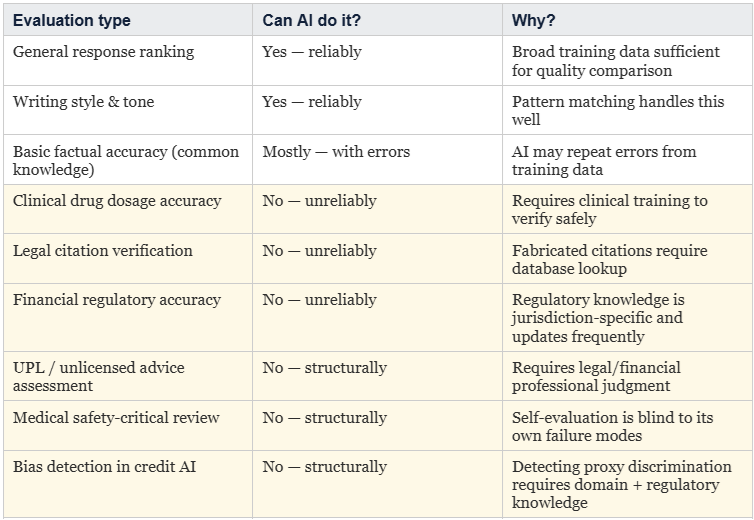
Highlighted rows indicate evaluation categories where domain-expert human review remains the industry standard and RLAIF has not demonstrated reliable substitution.
What This Means for the AI Evaluation Career Market
The market for AI evaluation work has stratified. There is a commodity tier — basic preference ranking, general writing quality assessment, simple factual checks — where rates are low, supply is high, and automation pressure is real. This tier was never the target for professional domain-expert evaluation.
And there is a specialist tier — domain-specific factual verification, regulatory accuracy assessment, safety-critical review, professional boundary evaluation — where demand continues to grow, qualified supply is genuinely constrained, and automation has not made meaningful inroads. This is the tier that clinical, legal, and financial professionals enter when they bring structured evaluation methodology to their domain expertise.
The rate differential between these tiers reflects the gap in what they require. Basic evaluation tasks on platforms like Scale AI and Outlier AI pay $10–$20 per hour. Domain-expert evaluation tasks on the same platforms, and direct client contracts with AI companies deploying specialist tools, pay $35–$120+ per hour. The difference is not marginal. It reflects genuine scarcity of qualified evaluators.
| “The automation risk in AI evaluation is real and it has already played out — at the bottom of the market. The question is not whether basic evaluation will be automated. It already has been. The question is whether your evaluation work requires the kind of judgment that automation cannot replicate. Domain expertise, professional verification skills, and structured evaluation methodology are specifically what distinguish the work that remains from the work that was displaced.” |
The Honest Picture of What This Means for You
If you are a doctor, nurse, lawyer, paralegal, accountant, or financial analyst thinking about AI evaluation as a career path, the RLAIF question should not discourage you. It should sharpen your focus.
The evaluation work that your professional background qualifies you for is specifically the evaluation work that RLAIF handles poorly. Clinical safety review. Legal citation verification. Financial regulatory accuracy. Unlicensed advice boundary assessment. Bias detection in credit systems. These are the tasks that AI companies cannot route through an automated evaluation pipeline and expect reliable results — and they know it.
What separates the professionals who build sustainable income from AI evaluation from those who find the market underwhelming is usually not domain knowledge. It is evaluation methodology. The ability to apply domain expertise through a structured framework, document findings professionally, and produce evaluation output that an AI company can use directly in their quality assurance process without extensive post-processing.
Domain knowledge gets you into the specialist tier. Evaluation methodology is what keeps you there — and what determines where in the rate range you sit.
A Note on Where This Is Heading
It would be dishonest to present the current landscape as permanently fixed. AI capabilities are improving, and tasks that require domain expertise today may be more reliably handled by AI systems in three or five years. Anyone who tells you the domain-expert evaluation market is completely immune to long-term automation pressure is overselling.
What is true right now — and likely to remain true for the foreseeable future, given the pace at which regulatory requirements are expanding and the pace at which AI is being deployed in high-stakes professional domains — is that clinical, legal, and financial AI evaluation requires human domain expertise and will continue to for as long as:
- Regulators require human oversight of AI systems in high-risk categories
- AI companies face legal liability for outputs that harm users in professional domains
- Clinical, legal, and financial AI products are evaluated against professional standards that require professional judgment
- The failure modes of AI in specialist domains are systematically different from the failure modes that AI evaluation pipelines are trained to detect
All four of those conditions are currently becoming more true, not less. The EU AI Act is expanding mandatory human oversight requirements. AI liability frameworks are being established across multiple jurisdictions. Clinical and financial AI products are being evaluated under increasingly stringent regulatory standards. The gap between general AI capability and domain-specific professional judgment is well-documented and not closing at the rate required to displace professional evaluation.
The specialist evaluation market is not permanent. But it is robust, it is growing, and it is the right market to build credentials in right now.
Where to Go From Here
The first step is not signing up for an evaluation platform and hoping for the best. Platforms like Scale AI and Outlier AI require qualification assessments, and evaluators who pass those assessments with stronger domain methodology — structured rubrics, professional verification workflows, documented evaluation frameworks — consistently access better projects at better rates.
The second step is building a portfolio. AI companies making direct hire decisions want to see evaluated outputs, not just credentials. A portfolio of domain-specific AI evaluation work — with rubric scores, verification documentation, and written analysis — is more persuasive than a CV that lists professional qualifications without demonstrating evaluation capability.
Both of those steps are what the Crested Academy domain tracks are designed to support. The foundation track builds the evaluation methodology. The domain specialisation tracks — Medical, Legal, and Finance — apply it to the specific contexts where your professional expertise is most valuable. The portfolio you build in the process is the credential that opens doors to the specialist tier of the market.
RLAIF has made the basic evaluation market more competitive. It has made the specialist evaluation market more valuable. The question is which market you are preparing for.